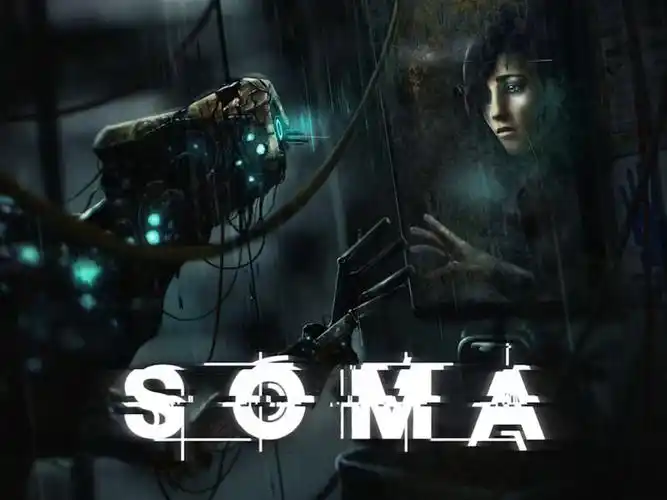
Developed by Frictional Games and released in 2015, SOMA is a first-person sci-fi horror narrative set in PATHOS-II, an underwater research facility at the bottom of the Atlantic Ocean. You play as Simon Jarrett, a young man from Toronto who, in 2015, underwent an experimental brain scan to diagnose a neurological condition. He wakes up in a decrepit, abandoned station in 2104, with no memory of how he arrived. The facility is in ruins, the staff are dead or transformed into grotesque biomechanical creatures, and the only friendly voice belongs to Catherine Chun, a scientist who communicates with Simon through terminals and intercoms. There is no traditional combat in SOMA. Your only option when faced with hostile creatures is to hide, run, or outsmart them. The game’s horror is not primarily derived from these encounters, but from the philosophical questions that unfold through environmental storytelling, audio logs, and the increasingly desperate conversations between Simon and Catherine.
Chapter Walkthrough and Monster Avoidance Strategies
Upsilon — The Awakening
Simon awakens in a small room in Upsilon. The facility is dark, the corridors are flooded in places, and the machinery groans with the strain of decades without maintenance. Your first task is to find a way to communicate with the outside world. Follow the corridor until you reach a control room where you can access a terminal. Catherine’s voice will guide you from here.
There are no hostile creatures in Upsilon, but the environment itself is hostile. The flooding in the lower corridors can short-circuit electrical panels. Listen for the crackling sound of exposed wiring before wading into water. The omni-tool you pick up in the control room is your primary interface for the rest of the game — it opens sealed doors, accesses computer logs, and provides environmental readouts.
Lambda — The First Encounter
Lambda is where you encounter your first hostile creature, a Construct — a human body fused with machinery, shambling through the corridors on twisted limbs. Constructs are blind but highly sensitive to sound. Crouch to move silently. Do not run unless you are certain you are already detected. If a Construct hears you, it will investigate the source of the noise. Throw objects — bottles, chairs, loose debris — to create distractions and lure it away from your path.
The key objective in Lambda is to find a power cell to restore the elevator. The power cell is located in a storage room at the far end of the main corridor, but the Construct patrols the area in a loop. Observe its patrol pattern from a hiding spot. Wait for it to turn its back, then crouch-walk to the storage room. Do not linger in open areas — if the Construct turns and you are in its path, freeze. Do not move, do not breathe loudly, do not touch anything. It will eventually move on.
Delta — The Proxy Encounter
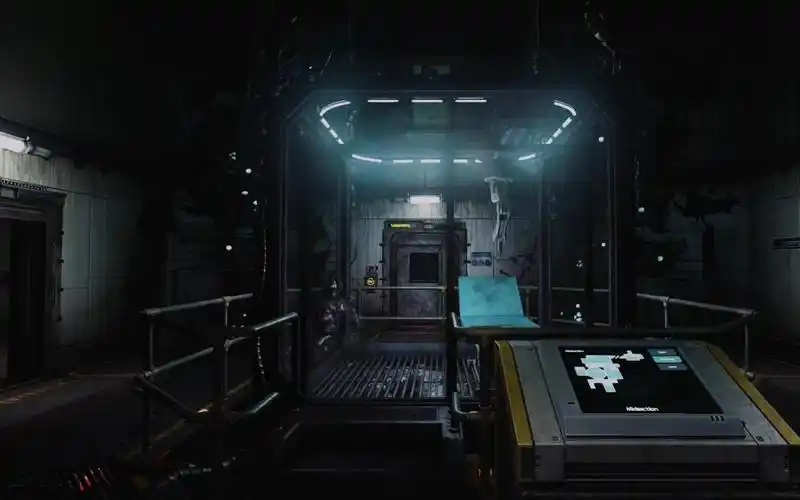
Delta introduces a new enemy type: the Proxy. Proxies are humanoid creatures with distorted faces and elongated limbs. They are not blind, and they will chase you if they see you. The strategy for Proxies is different from Constructs: you cannot simply sneak past them. You must break line of sight and hide.
The Delta chapter requires you to activate a series of pumps to drain a flooded section of the facility. The pump controls are in a central hub, and the Proxies patrol the corridors around it. The safest approach is to use the ventilation shafts that run above the main corridors. These shafts are accessible from several rooms and allow you to bypass most of the Proxy patrols entirely. Look for glowing green exit signs — they mark the entrances to the shafts.
A critical moment occurs when you must cross an open walkway while a Proxy patrols directly below. Time your crossing for the moment the Proxy turns to walk away from your position. If it sees you, do not hesitate. Run. The walkway has a door at the far end that you can close behind you, buying yourself time to find a hiding spot. The Proxy will eventually lose interest and return to its patrol route.
Theta — The Server Room
Theta is the narrative heart of the game. Here, Simon finally begins to understand what has happened to the world. The surface of the Earth was destroyed by a comet impact. The last humans are either dead or preserved in a digital simulation called the ARK, a project that Catherine was instrumental in creating. The ARK was launched into space, and the remaining staff of PATHOS-II either died or were transformed by a substance called structure gel — a biomechanical compound that can interface with both organic tissue and machinery.
There are no hostile creatures in Theta, but the chapter contains the most emotionally difficult sequence in the game. Simon discovers recordings of the last days of the PATHOS-II staff, and the desperation in their voices is harrowing. Take your time in this area. Read the terminals. Listen to the audio logs. The philosophical stakes of the game are established here, and rushing through will diminish the impact of the ending.
Omicron — The Abyss
Omicron is the game’s most dangerous area. The creature that haunts this station is the deepest-diving hostile in the game — a massive anglerfish-like monster called the Leviathan that patrols the flooded corridors. The Leviathan cannot be outrun in open water. You must use the environment — sunken machinery, collapsed walkways, broken pipes — to break line of sight and hide.
The objective in Omicron is to retrieve a piece of equipment necessary for launching the ARK. The equipment is located in a sealed laboratory at the bottom of the facility. You will need to navigate through flooded corridors while the Leviathan searches for you. Stay close to walls. Move only when the Leviathan’s bioluminescent lure is facing away from you. The sound of its approach is unmistakable — a low, resonant thrum that builds in intensity. When you hear it, find cover immediately and do not move until the sound fades.
Tau and Phi — The Final Descent
The final chapters take Simon into the deepest parts of PATHOS-II. Tau is home to another Proxy variant, but by this point, you should be familiar with the strategy — break line of sight, hide, wait, move. The real challenge is environmental. The corridors of Tau are tight and claustrophobic, and the structure gel that coats the walls pulses with an organic rhythm that is deeply unsettling.
Phi is the final station, and it contains the game’s climactic choice. The ARK is ready to be launched, and Simon must decide how to proceed. The choice is presented not as a dialogue option but as an action. You either complete the launch sequence, or you do not. The game does not tell you which is correct. It simply asks you to decide, and then it shows you the consequences of your decision.
The Two Endings
SOMA has two endings, and both are presented to the player in sequence, which is a deliberate and devastating narrative choice. The first ending shows the ARK successfully launching into space. Simon awakens inside the simulation, reunited with Catherine in a peaceful, beautiful digital afterlife. The survivors are safe. The human race, in some form, will continue.
Then the game cuts back to PATHOS-II. The Simon who remained behind — the original Simon, who is still sitting in the chair at the bottom of the ocean — asks Catherine what happened. She explains the fundamental truth that the game has been building toward: copying a consciousness does not transfer it. The Simon on the ARK is a copy. The Simon in the chair is still here, still alone, still trapped at the bottom of the ocean in a world that is already dead. Catherine’s systems fail. Simon is left alone in the darkness.
The second ending is triggered if Simon chose not to launch the ARK. In this version, the ARK is destroyed, and Simon remains in PATHOS-II with no objective and no hope of escape. This ending is even bleaker, but it is consistent with the game’s philosophical position: there are no easy answers to the questions SOMA asks.
Thematic Interpretation: The Problem of Continuity
SOMA is fundamentally a game about the nature of identity. Every time Simon’s consciousness is transferred — from his original body to the diving suit, from the diving suit to the deep-sea suit — a new copy is created while the old one is left behind. The game asks, with relentless clarity, whether the copy is the same person as the original, and whether it matters.
The coin toss is the game’s central metaphor. Catherine describes consciousness transfer as a coin flip — you have a fifty percent chance of waking up in the new body. Simon clings to this hope throughout the game, believing that he will be the one who makes it. The ending reveals the lie: there is no coin toss. The original always stays behind. The copy always wakes up somewhere new. The horror of SOMA is not that the monsters will catch you. It is that you were never going to be saved in the first place.