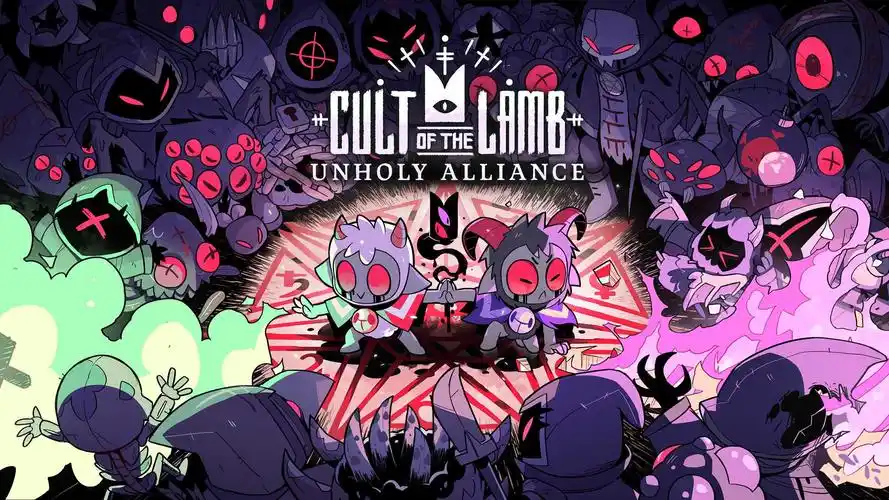
Developed by Massive Monster and published by Devolver Digital, Cult of the Lamb is a hybrid action roguelite and base-building management game released in 2022. You play as a lamb who is sacrificed by a group of heretics and brought back from the brink of death by a mysterious entity known as The One Who Waits. In exchange for your resurrection, you are tasked with building a cult in its name and eliminating the four Bishops who rule over the Old Faith. The game splits its time between two interconnected halves: dungeon crawling, in which you fight through procedurally generated rooms to gather resources and defeat bosses, and cult management, in which you construct buildings, tend to your followers, and perform rituals to grow your influence.
Dungeon Combat and Weapon Selection
Combat in Cult of the Lamb takes place across four distinct dungeon biomes, each themed around one of the four Bishops. The dungeons are procedurally generated, with rooms that contain combat encounters, resource caches, shops, and occasional NPC interactions. The goal of each run is to defeat the biome’s boss, which unlocks the next stage of the main story.
The lamb fights with a combination of melee weapons and curses, which are magical abilities that consume Fervour, a resource built by striking enemies. Weapons are randomly assigned at the start of each run from a pool of five types. The Sword is a balanced weapon with moderate speed and damage, and is the safest choice for new players. The Axe is slower but deals more damage and has a wider arc, making it effective against groups. The Dagger is the fastest weapon, allowing you to land several strikes in quick succession before dodging away. The Hammer is the slowest and most powerful, capable of staggering enemies in one or two hits. The Gauntlets are a close-range option with a rapid combo that can stun-lock smaller enemies.
Curses provide ranged and area-of-effect options. Common curses include fireballs, poison clouds, and freezing blasts. Each curse has a Fervour cost, and managing Fervour efficiently is key to surviving longer runs. It is generally advisable to save curses for larger enemies and boss fights rather than spending Fervour on smaller, easily managed threats. Curses can be upgraded by collecting Commandment Stones found in dungeons.
Tarot Cards offer passive bonuses for the duration of a single run and are acquired from the Tarot NPC, who appears randomly in dungeon rooms. The effects range from simple stat increases to more transformative modifications. Some cards increase damage dealt while reducing health, while others grant health regeneration at the cost of reduced movement speed. Choose cards that complement your current weapon and playstyle.
Doctrines, Rituals, and Cult Management
The cult management half of the game takes place in your base, a patch of land that you gradually expand by constructing buildings and tending to your followers. Followers are recruited during dungeon runs and can be indoctrinated into your cult upon returning to base. Each follower has a loyalty level that determines how effectively they work and how resistant they are to dissenting opinions.
Doctrines are the most important strategic choices in the game. Each time you collect three pieces of a Commandment Stone, you can declare a new Doctrine for your cult. Doctrines are divided into five categories, each governing a different aspect of cult life. Sustenance covers food and farming. Law and Order governs discipline and dissent. Possessions deals with wealth and tithes. Afterlife concerns death and resurrection. Work and Worship manages labor and devotion.
Each Doctrine presents a choice between two options, and the choice is permanent for that save file. For new players, several Doctrine choices stand out as particularly valuable. In the Sustenance tree, the Feast Ritual allows you to fill all followers’ hunger bars simultaneously, which is invaluable during the early game when food supplies are inconsistent. In the Law and Order tree, the Murder action allows you to permanently eliminate a dissenting follower, preventing dissent from spreading. In the Afterlife tree, the Resurrection ritual returns a dead follower to life, saving you the time and resources required to recruit and indoctrinate a replacement. In the Work and Worship tree, the Loyalty Enforcer ritual increases the loyalty of all followers, stabilizing your cult during periods of rapid expansion.
Rituals are performed at the temple and consume bones, a resource collected from defeated enemies and deceased followers. Different rituals provide different benefits, from boosting follower loyalty to increasing crop yields. Rituals are an essential tool for managing your cult’s mood and productivity, and you should perform them regularly rather than hoarding bones.

Follower Management and Base Building
Your followers are the engine of your cult’s growth. They perform tasks such as farming, mining, and praying at shrines to generate Devotion, which is used to unlock new buildings and upgrades. Followers have needs: they must be fed, sheltered, and kept healthy. Neglecting these needs will cause followers to become unhappy, and unhappy followers will dissent, spreading their dissatisfaction to others.
Hunger is the most immediate concern. Followers will eat any food available, and if no food is present, they will starve. Build farming plots early and assign followers to tend them. The Farmhouse automates the farming process, causing assigned followers to plant and harvest crops without manual intervention.
Sickness spreads through unsanitary conditions. Build outhouses and cleaning stations to maintain hygiene. Sick followers can be healed at the medbay, but prevention is far more efficient than treatment.
Dissent is the most dangerous threat to your cult. A dissenting follower will preach against you, lowering the loyalty of other followers. You can re-educate dissenters in prison, but this takes time. The more direct solution, unlocked through the Murder Doctrine, is to eliminate them. This will temporarily frighten your other followers but will stop the spread of dissent immediately.
Base building should prioritize function over aesthetics in the early game. The most important early structures are the Farm, the Shrine, and the Shelter. The Farm provides food. The Shrine generates Devotion. The Shelter allows followers to rest and recover. Once these basics are established, expand into specialized buildings such as the Lumberyard and Stone Mine, which generate resources used for construction.
Hidden Bosses and Endgame Content
In addition to the four main Bishops, Cult of the Lamb features several hidden bosses that are unlocked by completing specific tasks. These bosses are more difficult than the main story encounters and reward unique items and follower forms.
The One Who Waits is the final boss of the main story and can be fought after defeating all four Bishops. The battle is challenging and features multiple phases, each more aggressive than the last. After defeating The One Who Waits, the game presents a choice that determines your ending.
Several post-game bosses were added in free updates following the game’s release. These bosses are accessed through the Purgatory area, which becomes available after completing the main story. Each boss in Purgatory is a remixed, more difficult version of a boss from the main game, with new attack patterns and higher health pools.
The game also features a number of achievements tied to specific challenges, such as defeating a boss without taking damage or collecting every follower form. These achievements are tracked in the game’s menu and provide additional goals for players who have completed the main story.