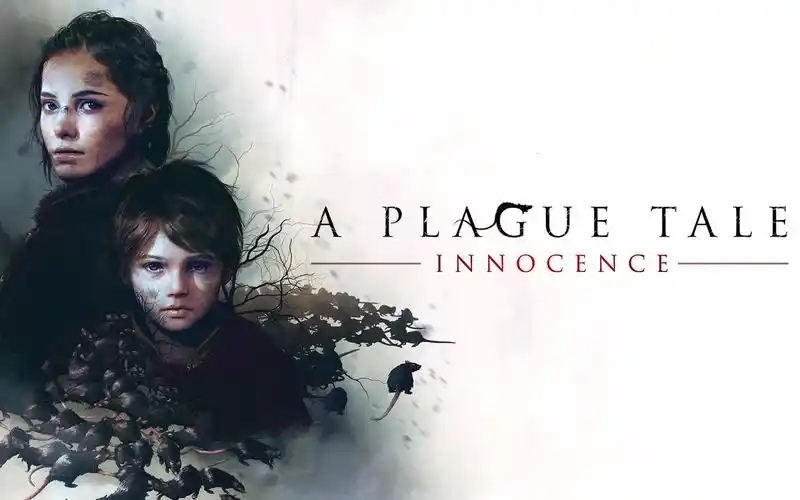
Developed by Asobo Studio and released in 2019, A Plague Tale: Innocence is a stealth narrative adventure set in 1348 France during the outbreak of the Black Death. You play as Amicia de Rune, the teenage daughter of a noble family, whose peaceful life is shattered when the Inquisition arrives at her family’s estate, murders her parents, and forces her to flee with her five-year-old brother, Hugo. Hugo is sick with a mysterious illness that has been present since birth, and the Inquisition wants him for reasons that will not become clear until late in the story. The game is structured across seventeen chapters, each one a desperate push forward through a world consumed by war, plague, and rats — millions of rats, which swarm in great tides that devour anything not illuminated by firelight.
Core Survival Mechanics
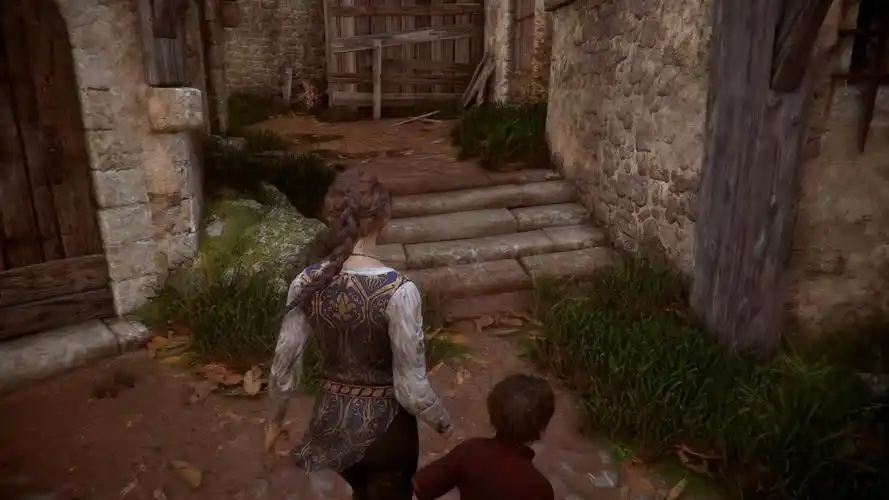
Amicia is not a warrior. She is a teenage girl with a sling and a handful of alchemical tools. Direct confrontation with armored soldiers almost always ends in her death. The game is built around three interlocking survival systems: stealth, resource management, and light manipulation.
Stealth is your default approach to every encounter. Amicia can crouch to reduce her visibility, move silently through tall grass, and distract enemies by throwing rocks or pots. Soldiers have predictable patrol routes, but they will investigate disturbances. A thrown rock that lands near a soldier will draw his attention to that spot. A rock that lands far from you but near an environmental hazard — like a caged rat swarm or a hanging brazier — can eliminate an enemy without direct confrontation.
Resource management is governed by a crafting system. Amicia can collect materials — Alcohol, Sulphur, Fabric, and Saltpeter — to craft ammunition and tools at workbenches scattered throughout each chapter. Resources are finite within each chapter and do not carry over between playthroughs. The most important crafting priority is Ignifer, which creates fire to light braziers and repel rats. Without Ignifer, you cannot progress through areas dense with rat swarms. The second priority is the basic rock supply for your sling. The third is Devorantis, a mixture that forces enemies to remove their helmets, exposing their heads for a sling shot.
Light manipulation is the key to controlling rat swarms. Rats are deathly afraid of light. Any illuminated area is safe. The moment the light goes out — because a brazier burns through its fuel, a torch is dropped, or a fire is extinguished by wind or water — the rats surge forward. Amicia can interact with light sources directly. She can ignite braziers with Ignifer, rotate them to change their illumination arc, push them along tracks to move the safe zone forward, or extinguish them to expose enemies to nearby swarms.
Key Crafting Priorities and Item Usage
The workbench upgrade system allows Amicia to permanently improve her equipment across several categories. The optimal upgrade path for new players is:
Sling Upgrades (First Priority): The sling pouch capacity upgrade allows you to carry more crafted ammunition before needing to stop and craft. The sling speed upgrade reduces the time between shots. A fully upgraded sling fires more than twice as fast as the base version, which is essential for chapters with multiple ranged enemies.
Alchemical Upgrades (Second Priority): The alchemical pouch capacity upgrade increases how many crafted items you can carry. The alchemical potency upgrade increases the effectiveness of Ignifer, Devorantis, and other mixtures. This upgrade is particularly valuable for the later chapters, where enemy density is high and you will rely heavily on alchemical tools.
Equipment Upgrades (Third Priority): Equipment upgrades reduce noise from movement, increase inventory space for resources, and reduce the cooldown time between ability uses. These are quality-of-life upgrades that make the game smoother but are not essential for survival.
Chapter Walkthrough and Key Strategies
Chapter 1-2: The de Rune Estate
The opening chapters serve as the game’s tutorial. Amicia is introduced to the sling, the crafting system, and the basic stealth mechanics in a low-pressure environment. The key lesson here is patience. Soldiers patrol slowly and predictably. Watch their routes before moving. Use tall grass to remain hidden. The sling can break chains holding hanging objects, which can be dropped on enemies for silent kills.
Chapter 3-4: The Village and the Church
These chapters introduce the rat swarms as an active environmental hazard. The village is partially overrun, and Amicia must navigate between islands of light while avoiding both rats and soldiers. Hugo’s presence complicates stealth — he will sometimes panic or wander, and you must hold his hand to guide him through dangerous areas.
Chapter 5-6: The Battlefield and the Aqueduct
Chapter 5 introduces large-scale combat environments. The battlefield is littered with the dead and dying, and the rats are present in overwhelming numbers. The key to this chapter is using Ignifer to create paths of light. Light one brazier, move to its edge, light the next, extinguish the previous one if fuel is running low, and keep moving.
Chapter 6, the aqueduct, is one of the game’s most challenging stealth sections. The area is patrolled by multiple soldiers in tight corridors. Use Devorantis to force helmeted enemies to expose themselves, then follow up with a headshot from the sling. The rat swarms in this chapter can be used as weapons — extinguish a soldier’s torch, and the rats will do the rest.
Chapter 7-9: The Forest and the Château
The forest chapters offer a brief respite from the rat swarms, focusing instead on human enemies and environmental navigation. The château introduces the Inquisition’s leadership — Lord Nicholas and his subordinates — and establishes the central conflict that will drive the remainder of the story.
Chapter 10-12: The Prison and the Cathedral
These chapters are the game’s emotional and mechanical climax. Amicia is separated from Hugo and must navigate the Inquisition’s prison alone. Without Hugo’s ability to sense enemies through the rat swarms, Amicia is entirely dependent on her own senses and tools. The prison is dark, its corridors are narrow, and the soldiers are numerous. This section rewards slow, methodical movement and generous use of crafting materials. Do not hoard resources — the prison is long, and there will be workbenches to restock at intervals.
The cathedral is the game’s most visually spectacular set piece. The rat swarms here are the largest in the game, and the chapter features a multi-stage confrontation with a corrupted Inquisition leader. The key to this fight is managing light sources while dodging the boss’s attacks. Ignifer is essential — without it, the darkness will consume you before the boss can.
Chapter 13-16: The Final Journey
The final chapters escalate toward the game’s conclusion. Hugo’s illness is revealed to be the Macula, an ancient curse that grants him power over the rats but also threatens to consume him entirely. The Inquisition’s goal is to weaponize the Macula, and Amicia’s only hope is to find a cure before Hugo is lost forever.
These chapters feature the most difficult enemy combinations in the game — multiple armored soldiers, shielded enemies, and environmental hazards all layered together. The crossbow, acquired late in the game, is silent and retrieves bolts from corpses, making it invaluable for thinning out enemy ranks before engaging.
Boss Encounters and Forced Combat
Several chapters feature forced combat sequences where stealth is not an option.
The Cart Sequence (Chapter 10): Amicia must push a cart to create a moving safe zone of light while rats swarm around her and soldiers attack. The strategy is to move the cart in short bursts, stopping to deal with soldiers as they appear. Use the sling to target unhelmeted enemies first, and save Devorantis for the armored ones.
Rodric’s Defense (Chapter 14): Amicia and Rodric, a blacksmith’s apprentice, must defend a position against waves of soldiers. Rodric is a melee powerhouse but cannot be everywhere at once. Use Amicia’s sling to support him — target archers first, then any soldiers flanking Rodric. This fight is about prioritization, not damage output.
The Final Confrontation (Chapter 16): The game’s final boss is a multi-stage fight against a figure central to the story. The mechanics vary by stage, but the core principle is consistent: control the light, control the rats, and the fight will follow.
Hidden Collectibles and Hugo’s Herbarium
Each chapter contains hidden collectibles in the form of flowers for Hugo’s herbarium and curiosity objects that provide historical context. The flowers are missable — they cannot be collected after completing a chapter without replaying the entire chapter. If you are aiming for full completion, consult a guide for flower locations before finishing each area.
The curiosity objects are scattered throughout the environment and are often hidden in side rooms or behind destructible barriers. They are not essential to the story but enrich the historical setting and provide additional context for the Inquisition’s activities and the nature of the plague.
Narrative Themes and Ending
A Plague Tale: Innocence is, at its core, a story about the loss of innocence — not just Hugo’s, but Amicia’s as well. Amicia begins the game as a sheltered noble girl who has never held a weapon. By the end, she has killed dozens of men, lost nearly everyone she loved, and been forced to make choices that no child should have to make. The game does not romanticize this transformation. It presents it as a tragedy, a necessary corruption driven by the need to protect the one person she has left.
Hugo’s Macula is a metaphor for the things we cannot control — the sicknesses we inherit, the darkness we carry, the parts of ourselves we fear will destroy the people we love. Amicia’s journey is not about curing Hugo. It is about choosing to stay with him, to protect him, to love him, even when he is dangerous, even when he is doomed, even when the world insists that he is a monster. The ending, which I will not fully describe here, honors that choice in a way that is both devastating and, in its own dark way, beautiful.