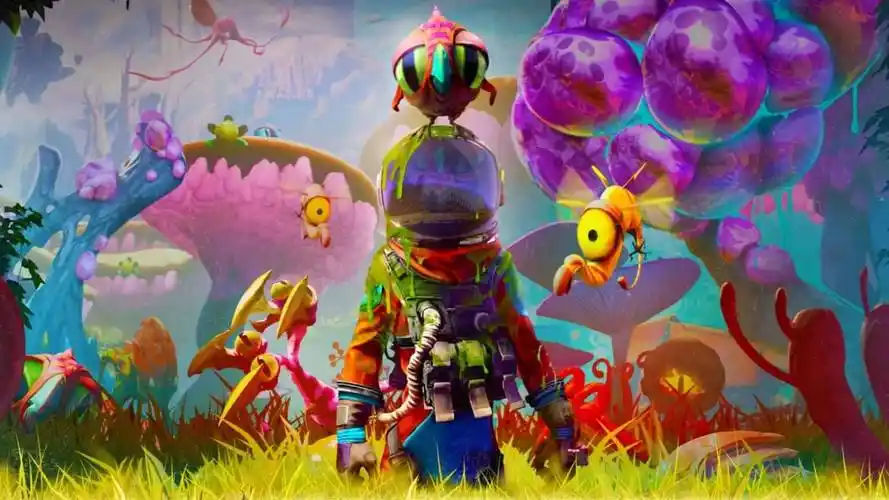
Developed by Typhoon Studios and published by 505 Games, Journey to the Savage Planet is a first-person action-adventure game that launched in January 2021 on PS5, PS4, Xbox Series X|S, Xbox One, Nintendo Switch, and PC. Often described by players as a blend of a comedic No Man’s Sky and a spacefaring Metroidvania, the game casts you as a rookie explorer for Kindred Aerospace, dropped onto an uncharted planet designated AR-Y26. Your mission is to survey resources for the company, catalogue alien lifeforms, and ultimately find a way off this absurd world. On the surface, it is a survival exploration game, but at its core, it is a darkly satirical comedy — your AI assistant encourages you with a chipper broadcast voice, yet behind every motivational phrase lurks a commentary on corporate exploitation and bureaucracy.
Exploration Core: Scan Everything, Overlook No Detail
The first and most important mechanic in Journey to the Savage Planet is the Scanner. The Scanner is not just a tool for understanding alien life; it is the engine that drives the entire game forward. Every plant and creature you scan is catalogued in your Planetary Encyclopaedia. Completing a certain number of scan targets raises your Exploration Rank, and ranking up directly unlocks new equipment and upgrade recipes.
For new players, the most practical rule is: scan everything you see. Scan what is alive, scan what is dead, scan the large, and scan the small even more diligently. Many microscopic creatures hide in rock crevices, treetops, or submerged corners, making them hard to spot with the naked eye. However, activating the Scanner highlights all scannable targets within your field of view, even if they are behind obstacles. If you find yourself stuck in a region, unable to reach the required number of scans to rank up, try switching the Scanner’s lens zoom or using a Gelatinous Blob to blow open a suspicious rock surface. The game contains numerous hidden areas that require you to blast or break your way in before they can be entered.
The value of scanning goes beyond accumulating experience. Certain critical area doors require a specific Exploration Rank to unlock, and these areas often hide rare materials or key pieces of equipment. The more diligently you scan, the sooner you gain access to these previously locked zones, creating a virtuous cycle of scanning, ranking up, unlocking new areas, and discovering yet more scannable species.
Resource Upgrades and Inventory Management
The resource system in the game is not overly complex, but it is easily underestimated by newcomers. Everything you gather on AR-Y26 — from basic minerals like Carbon, Silicon, and Aluminium, to alien fruits and creature glands — can be converted into equipment upgrades, item restocks, and technology unlocks at a 3D Printer. 3D Printers are scattered across the planet; you must locate and activate them in each region to transform the raw materials in your backpack into tangible combat power.
There is one easily overlooked detail regarding inventory management: your initial backpack space is extremely limited, and a portion of the resources you are carrying is dropped on death, forming a salvageable crate. You must return to that location to reclaim your lost materials before dying again. This mechanic implies two things. First, do not go too long without returning to a Printer to spend your resources — the longer you explore with a full backpack, the more you stand to lose when you die. Second, whenever you obtain a key material, prioritize finding the nearest Printer to use it up rather than waiting to amass a bigger stockpile for a bulk upgrade session.
In terms of upgrade order, Health and Backpack Capacity are the top two priorities. Health directly improves your survivability in combat and, more critically, during falls — the terrain of AR-Y26 is riddled with bottomless chasms and toxic swamps, and dying from a fall is far more common than being killed by enemies. Backpack Capacity allows you to carry more bombs, Gel Blobs, and healing items; an extra slot often translates directly into an extra life. Next in priority come Weapon Charge Speed and Scanner Range, both of which significantly improve your efficiency in combat and exploration. Damage upgrades should be the last consideration, because combat is not the central challenge in this game. Most enemies can be dealt with easily using a combination of bombs and standard gunfire.
Mastering the Rhythm of Combat and Movement
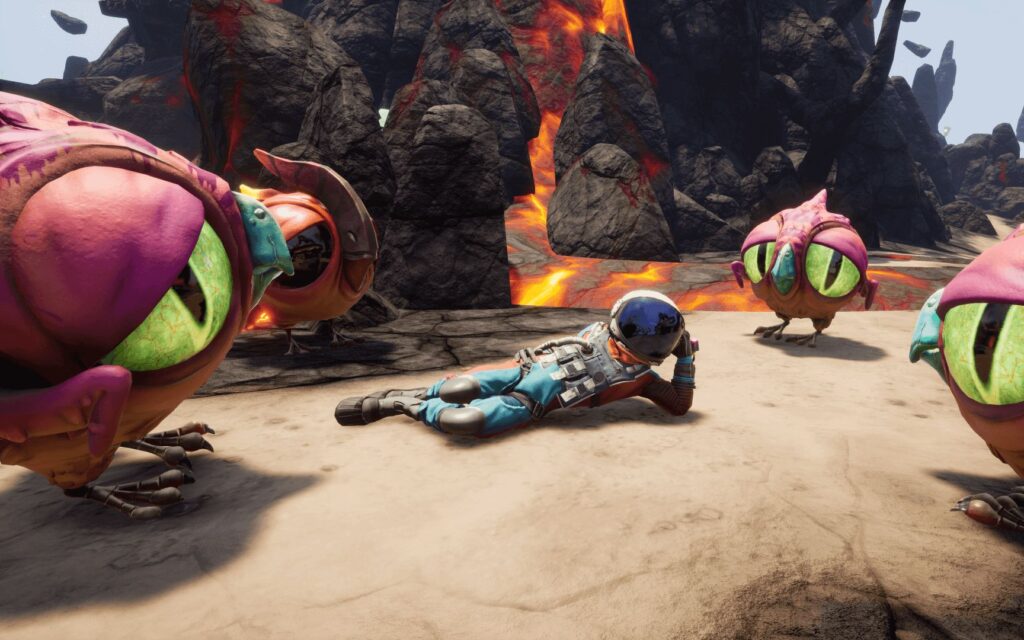
Combat in Journey to the Savage Planet is not the main focus, but it is punishing enough to trip up new players early on. Enemy attack patterns are mostly straightforward — charges, poison spit, explosions — but their damage output is far from negligible. Your basic weapon is a pistol. Later, you unlock a Gel Blaster, bombs, and a Shock Prod. The pistol has infinite ammo but low damage; bombs are powerful but must be crafted; and Gel Blobs are used for puzzles and temporarily freezing foes.
The single most important rule to remember during combat is: do not stand still and shoot. Your character has no cover and no armour. The only means of survival is movement and jumping. Alien creature attacks have extremely short wind-ups, and by the time you react to dodge, it is often already too late. A better habit is to remain airborne during fights — most enemy melee attacks cannot hit aerial targets, while your pistol can fire perfectly well in mid-air. Another practical strategy is to utilize the explosive flora found throughout the environment. The planet’s surface is dotted with pustule-like plants that detonate seconds after being touched or shot. Luring enemies near these plants before triggering the explosion is far more efficient than picking them off shot by shot with the pistol.
Regarding movement, the Jump Thrusters are the most worthwhile traversal tool to practice early on. Holding the jump button provides a brief burst of propulsion, extending your jump distance or allowing you to correct your direction in mid-air. Chaining together consecutive jumps and thrusts can reach high ledges that seem completely inaccessible from the ground, and these ledges often harbour resources or scannable targets. In the mid-to-late game, you unlock the Grapple Hook, which allows you to latch onto specific surfaces and launch yourself rapidly. This becomes essential equipment for crossing deep canyons and evading boss area-of-effect attacks.
Regional Exploration and Hidden Content
Planet AR-Y26 is divided into four main ecological regions: the Landing Site (temperate forest), the Itching Fields (toxic bog), the Glacial Tundra (snowy highlands), and the Crystal Caves (subterranean labyrinth). The visual style and enemy types vary drastically from one region to the next, but the exploration strategy remains universal: find the Teleporter and the 3D Printer first, then push deeper. A Teleporter serves as your safety net. Once activated, even if you die during exploration, you can respawn at the Teleporter and quickly return to the location of your death to reclaim your dropped loot.
As for hidden content, the developers of Journey to the Savage Planet clearly delighted in placing rare resources or easter eggs in seemingly unreachable locations. If you spot a floating rock platform, a ledge just beyond the maximum range of your jump thrusters, or a cave entrance partially concealed by vines, it is almost certainly accessible. Try blasting through vines with a bomb, paving a path with Gel Blobs, or executing a continuous combo of Jump Thrusters and Grapple Hooks. The game contains far more off-the-beaten-path routes than are marked on the map. Incidentally, the game’s ending is tied to your completion percentage. If you rush only the main objectives while neglecting extensive side exploration, the final cutscene will be remarkably short and dripping with sarcasm — likely a final joke from the development team aimed squarely at players who only wanted to speed through.