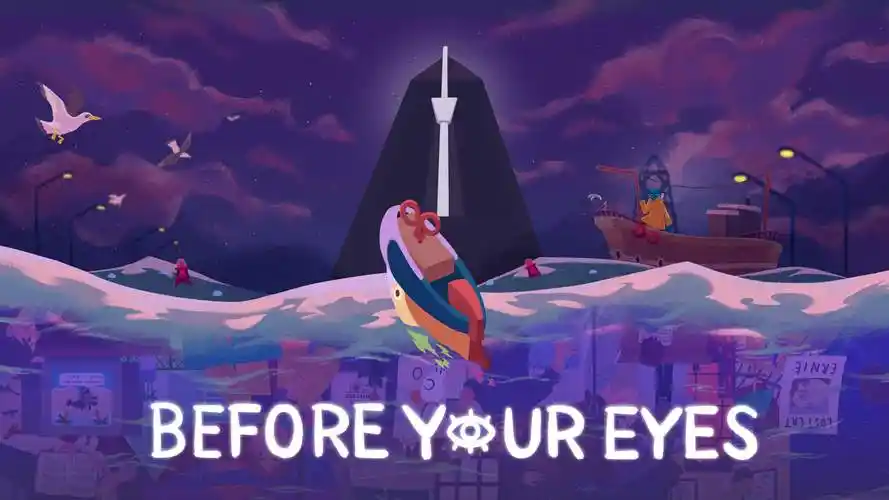
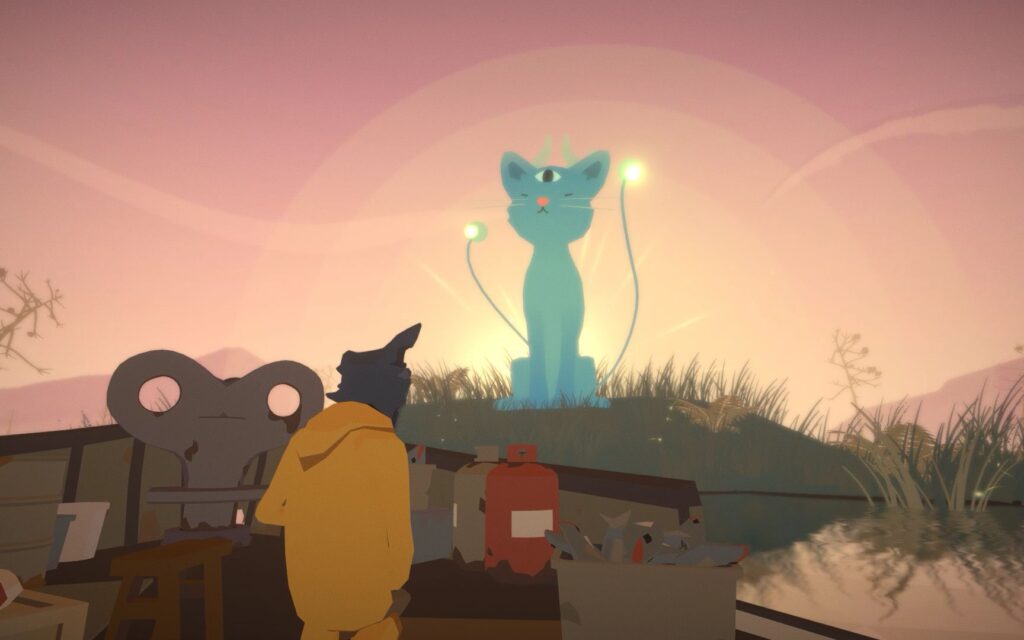
Developed by GoodbyeWorld Games and published in 2021, Before Your Eyes is a first-person narrative adventure that uses a webcam to track the player’s real-world eye blinks, translating them into the game’s central mechanic of pushing time forward. You play as Benjamin Brynn, a deceased soul being ferried to the afterlife by a wolf-like ferryman who asks you to recount your life story so that he may judge its worth. Every time you blink, the current memory fades and the next one rushes in, carrying you forward through Benjamin’s life — from his earliest childhood memories to his final moments. The game unfolds in a series of vignettes, each one a window into a moment that shaped who Benjamin became. There is no combat, no fail state, and only a handful of moments where the player can alter the course of the narrative. Instead, the game derives its power from the tension between the player’s desire to linger in beautiful moments and the inevitable blink that pulls them away.
The Blink Mechanic and Strategic Control
The blink mechanic is not merely a gimmick. It is the emotional engine of the entire experience. The game uses your webcam to detect when you blink, and each blink serves as a transitional command, moving you from the current memory to the next. The metronome at the bottom of the screen ticks steadily, and when the circle closes completely, the scene fades. But if you blink before the metronome completes, the transition happens instantly.
This creates a unique tension. When Benjamin is experiencing a happy memory — playing piano with his mother, painting with his father, meeting the person he will fall in love with — you will naturally want to hold your eyes open, to resist blinking for as long as possible, to stay in that moment. But your body will eventually override your will. You will blink, and the memory will be gone. This involuntary loss is the game’s central metaphor: time passes whether you want it to or not, and the moments we most want to hold onto are the ones that slip away fastest.
Conversely, during difficult memories — moments of failure, grief, or shame — the urge to blink is stronger, because closing your eyes is a natural response to pain. But blinking through these moments means missing them, and the game quietly records what you chose to see and what you chose to rush past.
Certain key moments in the game require deliberate blinking to progress. The ferryman will sometimes instruct you to blink to make a choice, or to close your eyes entirely for an extended period to enter a deeper memory. These moments are always clearly signposted by a change in the metronome’s appearance or a direct verbal prompt.
For players who do not have a webcam, or who prefer not to use one, the game offers an alternative control scheme using mouse clicks or controller inputs in place of blinks. The emotional impact of the story does not depend on the webcam, but the physical experience of involuntarily blinking away a moment you desperately want to keep is unique to the hardware-based interaction.
Key Memory Nodes and Hidden Branches
The ferryman guides Benjamin through his life in roughly chronological order, but there are moments where the player’s choices — what they look at, what they interact with, and how long they linger — unlock hidden branches in the narrative.
The first major branching point occurs in Benjamin’s childhood, during a sequence in which he discovers a piano in his family’s living room. If the player engages deeply with this memory — looking around the room, examining the sheet music, watching Benjamin’s mother’s face as she realizes her son has a gift — the piano will become a recurring motif throughout the rest of the game, and Benjamin’s musical talent will feature prominently in his later memories. If the player rushes through this scene, the piano fades into the background, and Benjamin’s life takes a different shape — one in which music is a hobby rather than a calling.
Another critical branching point occurs during Benjamin’s adolescence, when he must choose between attending a prestigious art school that would take him far from home, or staying close to his family. This choice is presented not as a dialogue option but as a physical action — Benjamin stands at a crossroads, and you must guide his gaze toward one path or the other. The consequences of this choice ripple through every subsequent memory, altering Benjamin’s relationships, his career, and the people who are present at his side during his final moments.
The relationship with Chloe, Benjamin’s childhood friend who becomes something more, is the most emotionally significant branch in the game. Your interactions with Chloe — whether you are patient with her when she struggles, whether you show up for her when she needs you, whether you blink through her most vulnerable moments or hold your eyes open to witness them — determine the depth and trajectory of their bond. In the game’s final act, the state of this relationship becomes the primary lens through which Benjamin’s life is judged.
Interpreting the Ending and the Ferryman’s Judgment
The climax of Before Your Eyes arrives when Benjamin reaches the end of his life story, and the ferryman must deliver his judgment. Throughout the game, the ferryman has been an ambiguous presence — part guide, part interrogator, part audience. He asks Benjamin to show him moments of greatness, of meaning, of beauty. He is skeptical when Benjamin offers simple, quiet memories instead of grand achievements.
In the game’s final moments, the ferryman’s judgment is revealed not as a verdict on Benjamin’s life, but as a reflection of what Benjamin himself believes about it. If Benjamin has revisited his memories with honesty — acknowledging his failures, accepting his losses, and holding onto the love he gave and received — the ferryman recognizes the worth of that life and grants him passage to whatever comes next. If Benjamin has rushed through his memories, avoiding the painful ones and skimming the surface of the joyful ones, the ferryman’s judgment is harsher — not because Benjamin’s life was worth less, but because Benjamin never truly saw it.
The game’s final sequence is an inversion of the blink mechanic. Instead of blinking to push time forward, you must keep your eyes open as Benjamin’s life flashes before you one last time — a montage of every moment you experienced, replayed at high speed, impossible to hold onto. And then, finally, you close your eyes, and the game ends.
There is no post-credits scene, no secret ending unlocked by collecting hidden items, no promise that Benjamin’s story continues beyond what you have seen. The game simply asks you to sit with what you experienced, and to carry the weight of a life that — like all lives — was messy and incomplete and, in its own quiet way, extraordinary. The ferryman’s final words to Benjamin are also his final words to the player: “You lived. That is enough.”
The hidden depth of Before Your Eyes lies in its understanding that a life is not measured by its greatest achievements or its worst failures, but by the accumulation of small moments — a mother’s hand on a piano, a father’s paintbrush on canvas, a friend’s laughter in the dark — that no one else will ever fully see. The game gives you a glimpse of someone else’s small moments, and then asks you, gently, to consider your own.