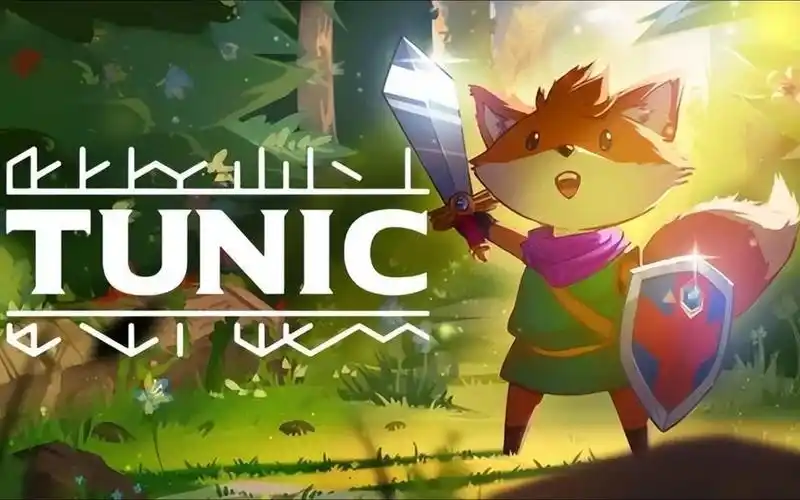
Developed by Andrew Shouldice and published by Finji, TUNIC is an isometric action-adventure game released in 2022. You play as a small fox who washes ashore on a mysterious island filled with ancient ruins, cryptic monoliths, and hostile creatures. The game presents itself as a charming homage to classic Legend of Zelda titles, with real-time combat, dungeons to explore, and items to collect. But beneath that familiar surface lies one of the most ingenious puzzle designs in modern gaming: an in-game instruction manual, its pages scattered across the world, written in a constructed language that the player must learn to decipher. The manual is not a menu or a help screen. It is the game’s central mystery, and understanding how to read it is the key to everything TUNIC has to offer.
Core Combat Mechanics and Survival Strategies
Combat in TUNIC is deliberate and methodical. The fox wields a sword and shield, and the basic moveset consists of light attacks, a dodge roll, and a shield block. There is a stamina meter that governs how many actions you can perform in sequence before you must pause to recover. Running out of stamina leaves you briefly vulnerable, unable to attack or dodge.
The dodge roll is your most important defensive tool. It provides a brief window of invincibility, allowing you to phase through enemy attacks if timed correctly. The roll can be chained up to three times in quick succession, but each roll consumes stamina, and spamming rolls will leave you exhausted in front of an enemy. The correct rhythm is to roll through an attack, land one or two strikes, and then roll away to reassess.
The shield is not a passive defense. Holding the shield button raises it, and any attack blocked will deplete a portion of your stamina rather than your health. If your stamina is fully depleted by a blocked attack, the shield breaks and you are briefly stunned. The shield can also be used to parry — pressing the shield button at the exact moment an attack lands will deflect it entirely and stagger the enemy, opening them up for a critical counterattack. Parrying is high-risk but high-reward, and mastering it is essential for the game’s tougher encounters.
The game features a variety of consumable items that can turn the tide of difficult battles. Firecrackers can be thrown to stun groups of enemies. Pepper increases your attack speed for a short duration. Blueberries restore health. These items are finite and must be found or purchased, so they should be used strategically rather than in every encounter. The game’s tougher boss fights are significantly easier if you have stockpiled consumables beforehand.
Enemy design in TUNIC rewards observation. Each enemy type has a distinct attack pattern, and the game expects you to learn these patterns through repeated encounters. The basic sword-wielding skeletons telegraph their swings clearly and are vulnerable after a missed attack. The larger, heavily armored guardians require you to dodge behind them and strike their exposed backs. The floating mages fire homing projectiles that can be dodged or deflected with a well-timed shield parry. Rushing into combat without first observing the enemy’s patterns will lead to frequent and frustrating deaths.
The Instruction Manual and Its Secrets
The instruction manual is the heart of TUNIC. Its pages are scattered throughout the world, hidden in chests, tucked behind waterfalls, and guarded by optional challenges. Each page is written in a constructed language that uses a unique runic script. At first, the pages appear indecipherable, but careful study reveals that the language is a simple substitution cipher based on English. The manual contains maps, item descriptions, combat tips, and narrative fragments — but only if you can read it.
The manual is not merely a collectible. It contains essential information that is not conveyed anywhere else in the game. The controls for special abilities, the locations of key items, and the solution to several puzzles are all hidden in plain sight within its pages. The game never explicitly tells you to study the manual. It simply trusts that you will, and the experience of gradually learning to read the manual’s language is one of the most rewarding puzzle-solving arcs in any game.
The most important secret hidden in the manual is the Holy Cross, a pattern of directional inputs that opens hidden doors and activates secret mechanisms throughout the world. The Holy Cross is never named or explained directly. Its existence is hinted at through diagrams in the manual that show directional arrows, and its uses are only revealed to players who experiment with those inputs in the right locations. Several optional areas and one of the game’s two endings are locked behind the Holy Cross.
The manual also contains a complete overworld map, annotated with icons indicating the locations of key items and hidden passages. Translating the map’s labels is one of the most practical uses of the manual’s language, as it will guide you to areas you may have overlooked.
Key Items and Ability Unlock Order
The fox begins the game with only a sword. Abilities and items are unlocked by exploring the world and defeating bosses, and the order in which you acquire them will shape your approach to exploration.
The Shield is found early in the game, in the Old House area. It is easy to miss if you do not explore thoroughly, and attempting to fight the game’s tougher enemies without it is punishingly difficult. If you have reached the first boss and still do not have the shield, retrace your steps and search the area near the starting beach.
The Wand is a ranged weapon that fires magic projectiles. It consumes magic points, which can be restored by picking up blue magic pickups or by resting at shrines. The Wand is found in the West Garden area and is essential for dealing with flying enemies and for triggering certain environmental switches.
The Grappling Hook allows the fox to latch onto specific anchor points and pull itself across gaps. It is found in the Frog’s Domain and unlocks access to several previously unreachable areas. Once you have the Grappling Hook, revisit earlier regions — there are hidden paths and treasure chests that were visible but inaccessible before.
The Prayer Book is a late-game item that allows the fox to pray at specific shrines, triggering environmental changes and unlocking the path to the final area. The Prayer Book is also used in conjunction with the Holy Cross to access the true ending.
The Laurels are the final ability unlocked in the game. They allow the fox to dash through certain barriers and are required to reach the true ending. The Laurels are tied to a series of puzzles that require full understanding of the manual’s language.
The Two Endings and How to Reach Them
TUNIC has two endings. The standard ending is accessible to any player who completes the main story — defeat the final boss, the Heir, and claim the power that awaits. The standard ending is satisfying in its own right, providing a resolution to the fox’s journey.
The true ending requires significantly more effort. To unlock it, you must collect all pages of the instruction manual, solve the riddle of the Holy Cross, and collect a series of secret items scattered across the world. These items are hidden behind puzzles that require you to understand the manual’s language and apply the Holy Cross in specific locations. The final step of the true ending path involves a puzzle that spans multiple areas of the map, requiring you to trace a specific pattern through the world itself. Completing the true ending recontextualizes the entire game and provides the closest thing to a full understanding of its mysterious narrative.
The manual itself provides the clues needed to find the true ending, but only if you have learned to read it. The game never tells you to pursue the true ending. It is a secret that exists for those who are curious enough to seek it.