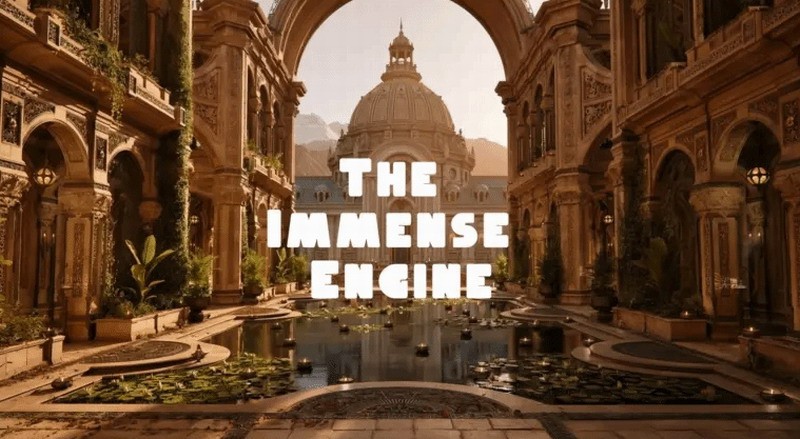
In May 2026, a notable development surfaced in the world of game technology: a new general-purpose game engine called The Immense Engine was officially unveiled. The project is being led by Arjan Brussee, former Chief Technology Officer at Epic Games and co-founder of Guerrilla Games. The engine is still in its early development stages, with the first technical demos expected in 2027.
Based on the information disclosed so far, The Immense Engine makes one choice that clearly sets it apart from the dominant engines currently on the market. It will not take a royalty cut from game revenues. Instead, it will operate on a flat annual subscription fee. Once a developer has paid for the yearly license, no additional payments to the engine provider will be required, regardless of how many copies the finished product sells. This model is designed primarily with mid-sized and smaller studios in mind, offering an alternative path for teams that find revenue-sharing structures difficult to shoulder.
On the technical side, the directions announced for The Immense Engine include native support for multi-platform export, a built-in high-dynamic-range lighting system, and deep integration with procedural content generation. Brussee has stated in a technical presentation that the engine’s architecture was optimized from the start for two specific scenarios — large-scale open worlds and high-density urban environments — while emphasizing that this focus would not come at the expense of versatility across other game genres. The engine is being built through a co-development approach: several studios have already been brought in during the early phases to test features and provide feedback, allowing real-world toolchain experience to shape modifications while development is still underway.
The arrival of The Immense Engine makes it a rare new entrant in a field that, for a long stretch of time, has been dominated by two platforms. The challenge facing The Immense Engine is not only one of catching up technologically, but also one of ecosystem-building — documentation, tutorials, asset stores, and community support all have to be constructed from the ground up. Brussee’s response to this has been to share the cost of ecosystem development among partner studios during the initial phase, and to plan for the open-sourcing of select engine components once the engine reaches a commercially viable state, as a way of drawing in community contributions.