On July 15, 2026, Sucker Punch Productions published a twelve-minute developer deep-dive video via the official PlayStation Blog, offering the first comprehensive look at the core gameplay systems of Ghost of Tsushima: Shadows Beyond, the sequel to the acclaimed 2020 title. This marks the first time the development team has systematically showcased actual gameplay details since the game was first revealed as the final highlight of the June 2026 State of Play. In the video, Creative Director Nate Fox appeared alongside members of the combat design team to walk through the key differences in combat, open-world exploration, and narrative structure that set the sequel apart from its predecessor.
Dynamic Season System and Environmental Tactics
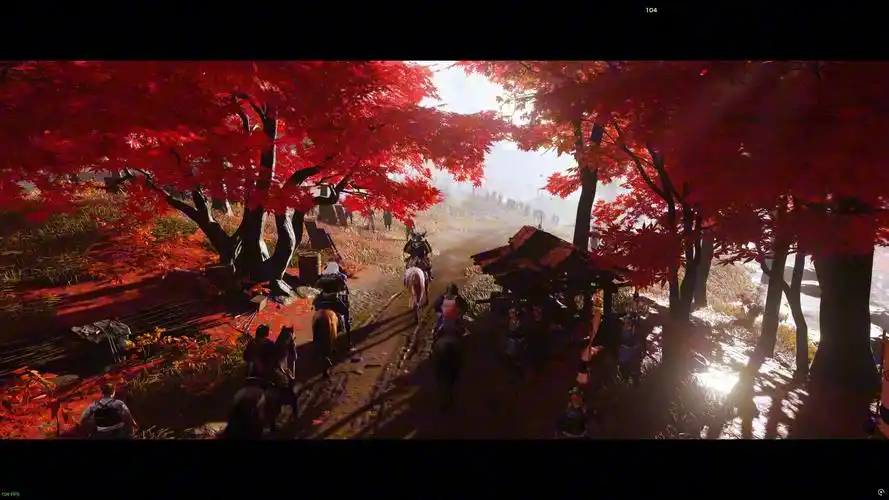
The most striking new mechanic revealed in the demonstration is the Dynamic Season System. Unlike the fixed autumnal setting of the first game, the open world of Shadows Beyond will naturally cycle through spring, summer, autumn, and winter as the main story progresses. Each season not only brings a complete visual transformation — cherry blossoms blanketing the mountains in spring, torrential downpours in summer, crimson foliage in autumn, and knee-deep snow in winter — but more importantly, the seasons directly alter enemy patrol patterns, environmental interactions, and the tactical resources available during combat.
The demonstration used a winter scenario as a detailed example. When Tsushima is blanketed in deep snow, the player character’s movement speed is slightly reduced, but the footprints left behind can be used to track enemies. Conversely, the player also leaves footprints in the snow, which enemies can use to detect the player’s position. Winter blizzards intermittently reduce visibility to near zero, creating natural cover for stealthily approaching enemy encampments, while simultaneously limiting the effectiveness of long-range archery. In contrast, the frequent heavy rains of summer loosen bowstrings, reducing arrow power and accuracy, but the sound of rainfall masks the player’s footsteps, making stealth approaches far more effective. Fox explained in the video, “We wanted the seasons to be more than just a backdrop. They are a tactical variable. You need to consider the current seasonal conditions before entering every fight, just as you would consider an enemy’s unit composition.”
New Weapons and the Evolution of Combat Stances
On the combat front, Shadows Beyond introduces two brand-new weapons alongside the original four stances: the Naginata and the Wakizashi, along with their corresponding new stances — Storm Stance and Shadow Stance.
The Naginata is a polearm with long reach and strong stagger potential, but a relatively slow attack speed. Its corresponding Storm Stance specializes in crowd control; its charged attack unleashes a horizontal arcing slash that knocks back multiple surrounding enemies simultaneously. Storm Stance is highly effective at breaking the guard of shield-bearing enemies and heavily armored units, making it the optimal choice for frontal assaults.
The Wakizashi is a short blade with the shortest range but the fastest attack speed in the game. Its corresponding Shadow Stance focuses on single-target burst damage and precision assassinations. The core mechanic of Shadow Stance is the “Zanshin Strike” — upon successfully dodging an enemy attack at the very last moment, the character automatically circles behind the enemy and delivers a single, armor-ignoring critical hit. The timing window for this move is extremely tight, but a successful trigger can eliminate almost any enemy short of a boss in a single strike. The combat design team stated that Shadow Stance was designed to provide a higher skill ceiling for veteran players who have already mastered the original game’s Standoff and Perfect Parry mechanics.
The four original stances — Stone, Water, Wind, and Moon — are all retained, and each can now unlock additional branching moves through the skill tree. Stance switching is no longer solely tied to countering specific enemy weapon types; players can now freely mix stances based on combat scenarios and personal preference — switching to Storm Stance for crowd control against multiple foes, or shifting to Shadow Stance to pursue a one-hit kill against a single powerful enemy.
Two-Player Co-op and Standalone Campaign Mode
The video also formally confirmed a feature that had only been briefly mentioned previously: a full two-player online co-op mode. In Shadows Beyond, players can invite a friend to join their game and explore the open world of Tsushima together. Co-op mode is not simply a replication of the main campaign; it introduces a full set of cooperative mechanics. Two players can synchronize a “Twin Standoff” — challenging two enemies simultaneously at the same rhythm — which, when successful, triggers a unique dual-execution animation. Co-op mode also features dedicated cooperative stealth routes and hidden areas that require both players to work together to unlock.
More surprisingly, co-op mode will include an independent “Co-op Campaign,” composed of a series of missions specifically designed for two players, telling the story of a key supporting character from the main narrative, set apart from the protagonist’s journey. Fox confirmed that this co-op campaign will last approximately eight to ten hours. Its completion will not affect the main story’s ending, but it will provide additional narrative layers to the overall story.
Release Window and Future Plans
The release window for Ghost of Tsushima: Shadows Beyond remains set for 2027, with no specific date yet announced. Sucker Punch confirmed at the end of the blog post that the game is being developed simultaneously for PS5, PS5 Pro, and PC — a departure from the strategy of the first game, which launched as a timed console exclusive before being ported to PC. Fox concluded the video by saying, “We hope that Shadows Beyond is not only a tribute to its predecessor, but an expansion of this world. The story of Tsushima is far from over, and we’ve only just begun to reveal its next chapter.”