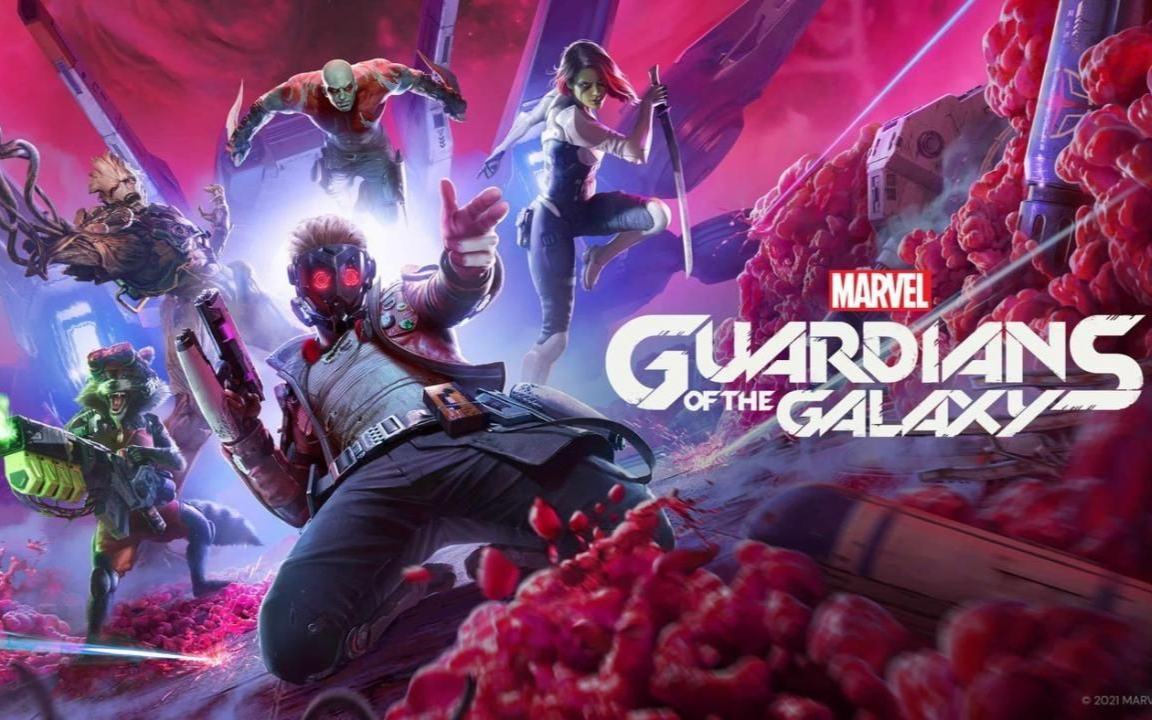
Developed by Eidos-Montréal and published by Square Enix, Marvel’s Guardians of the Galaxy launched in 2021 and went on to win the award for Best Narrative at The Game Awards that same year. You play as Peter Quill, also known as Star-Lord, leading the rest of the Guardians — Gamora, Drax the Destroyer, Rocket, and Groot — on a chaotic adventure across the cosmos that begins with a simple bounty hunt and spirals into a galaxy-threatening crisis. The game is a linear, story-driven third-person shooter with a deep emphasis on team combat and character-driven dialogue. It does not require any prior knowledge of the Marvel universe or the Guardians films.
The Team Command System
Combat in Marvel’s Guardians of the Galaxy is not about solo performance. Star-Lord’s blasters are serviceable but deliberately underpowered compared to the capabilities of his teammates. The game’s central mechanic is the Team Command System, which allows you to pause the action, issue orders to each Guardian, and then watch them execute devastating attacks in sequence. This system is not optional — you will struggle to defeat even basic enemies if you ignore your teammates and try to solo every fight.
Each Guardian has a unique set of abilities, and each ability falls into one of two categories: damage and stagger. Damage abilities deal direct health damage. Stagger abilities fill an enemy’s stagger bar, displayed below their health bar. Once the stagger bar is full, the enemy is temporarily stunned and takes bonus damage from all sources. Effective combat requires balancing these two types of abilities — use stagger moves first to immobilise priority targets, then follow up with damage abilities to finish them off.
Gamora is the team’s single-target executioner. Her damage output is the highest in the group, and her abilities are designed to eliminate high-value targets quickly. Use Gamora against elite enemies and bosses whenever her abilities are off cooldown.
Drax is the team’s primary stagger specialist. His heavy attacks fill stagger bars faster than any other Guardian’s abilities, making him essential for setting up damage windows on tough enemies.
Rocket excels at area-of-effect damage. His grenades and multi-target attacks are ideal for clearing groups of weaker enemies that would otherwise chip away at your health. He is also the fastest character, making him useful for dealing with enemies that teleport or reposition frequently.
Groot is the team’s support and crowd-control anchor. His roots can immobilise enemies, holding them in place while the rest of the team unloads. His healing ability, unlocked through progression, is the only source of direct healing in the game beyond Star-Lord’s limited health pickups.
Star-Lord himself is the lynchpin of the team. His blasters are reliable for sustained damage, but his most important contribution is the Huddle ability. When activated, Star-Lord gathers the team for a pep talk. The dialogue that follows is influenced by your performance in the current fight. If the team is doing well, the Huddle will provide a significant damage boost. If the team is struggling, the Huddle will restore health instead. The Huddle is on a long cooldown, so use it at pivotal moments — when a boss enters a new phase, or when multiple elite enemies spawn simultaneously.
Elemental Combos and Enemy Weaknesses
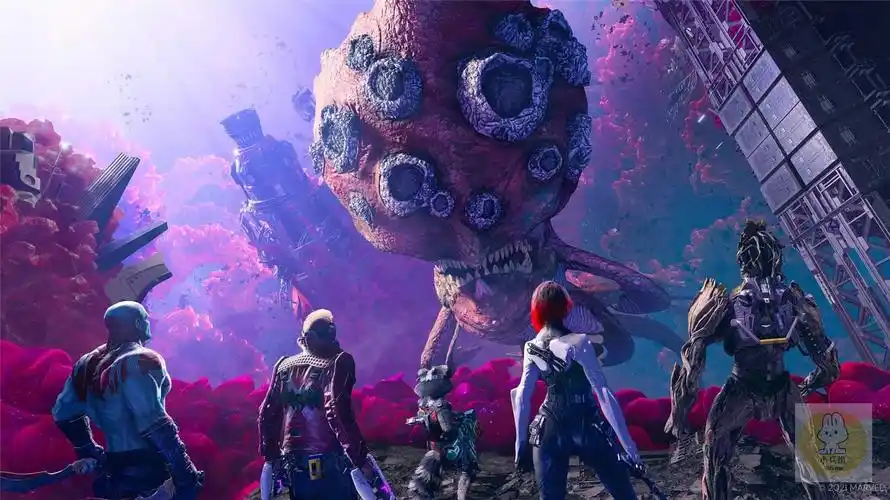
Each Guardian’s attacks are associated with one of four elements: Plasma (fire), Shock (lightning), Frost (ice), and Wind. Enemies have specific elemental weaknesses, and hitting an enemy with the correct element deals bonus damage and may trigger additional effects. For example, hitting a frozen enemy with a shock attack will cause them to shatter for massive damage. Hitting a plasma-affected enemy with a wind attack will spread burning embers to nearby foes.
Elemental interactions are not merely a bonus; they are essential for efficient combat in the later chapters. Rocket’s attacks are primarily Shock-based. Drax’s are Plasma. Gamora’s are Wind. Groot’s are Frost. Star-Lord’s blasters can be modified through perks to deal any of the four elements, making him the team’s wildcard for triggering combos.
The optimal combat loop involves identifying the most dangerous enemy in a group, checking its elemental weakness using Star-Lord’s visor scan, and then issuing commands in sequence: stagger the target with Drax, immobilise with Groot, then detonate the combo with the appropriate element from Rocket or Gamora, with Star-Lord providing follow-up damage and picking off weakened stragglers.
Perk System and Progression
Perks are passive bonuses that modify Star-Lord’s abilities and the team’s overall effectiveness. Perks are unlocked by finding components scattered throughout each chapter. Some are hidden in optional side paths, while others are awarded automatically as the story progresses. You can equip a limited number of perks at any time, and you can swap them out at workbenches found on the Milano, the team’s ship, between missions.
A handful of perks stand out as particularly valuable for new players. Perfect Dodge extends the invincibility window on Star-Lord’s dodge, which is essential for surviving boss encounters. Team Cooldown Reduction shortens the time you must wait between issuing commands, allowing you to maintain a more aggressive pace. Blaster Overcharge increases the damage of Star-Lord’s charged shots, which are already his most effective tool for dealing with single targets.
Components for perks are finite per playthrough, so you cannot unlock every perk in a single run. Prioritise the perks mentioned above before branching into more situational options. If you miss components in a chapter, they can be collected in New Game Plus, which carries over all unlocked perks and abilities.
Chapter Collectibles and Dialogue Choices
The Milano serves as the game’s hub between missions. It is here that you can converse with each Guardian, explore their personal quarters, and unlock optional backstory conversations. These conversations are not filler — they deepen the relationships between the characters and, in several cases, unlock unique perks or alternate dialogue paths in later missions.
Each chapter contains hidden collectibles in the form of Guardian Collectibles — objects tied to each character’s backstory, such as Gamora’s childhood keepsakes, Drax’s meditation stones, and Rocket’s engineering tools. Finding these items and returning them to the appropriate Guardian triggers special dialogue and, in some cases, unlocks bonus costumes. The costumes are purely cosmetic but are among the game’s most appreciated collectibles, as they draw from decades of Marvel comics history rather than the film adaptations.
Collectibles are often tucked away in side rooms, behind destructible obstacles, or at the end of brief platforming detours. The game does not allow you to backtrack within a chapter, so if you care about collecting everything, you should explore thoroughly before moving through any door or corridor that triggers a cutscene. If you miss a collectible, the chapter select feature — unlocked after completing the game — allows you to replay individual chapters to pick up what you missed.
The game’s dialogue system is real-time and unlabelled. There are no dialogue wheels with alignment indicators. Instead, during conversations, Star-Lord is presented with timed response options, or the opportunity to remain silent. The choices you make influence how the Guardians respond to you in future encounters and can shape the tone of key narrative moments. There is no “correct” answer — the game rewards authenticity over optimisation.