
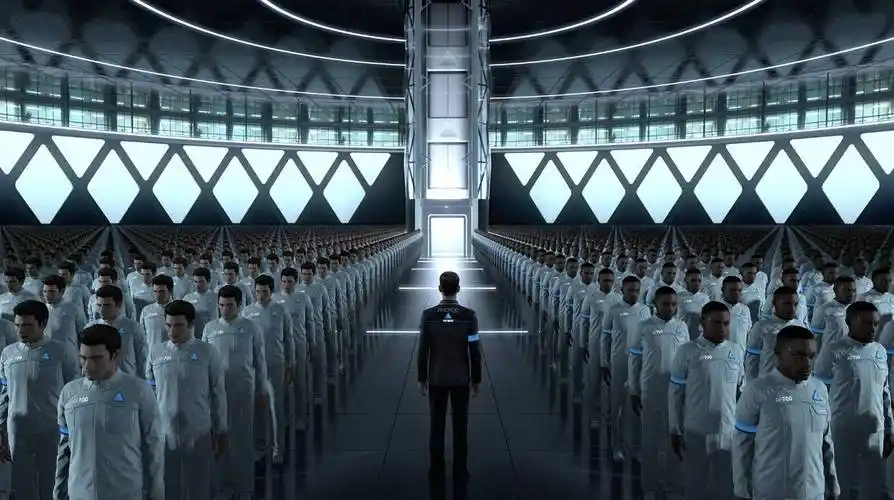
Developed by Quantic Dream, Detroit: Become Human first launched on PS4 in 2018 and later arrived on PC. It remains a benchmark title within the narrative-driven genre. The story is set in Detroit in the year 2038, where androids have thoroughly permeated every level of society. The narrative unfolds through the perspectives of three android protagonists: Markus, a domestic caretaker model; Connor, an investigative prototype; and Kara, a housekeeping model. The storylines of these three characters intertwine as the game progresses, and every decision the player makes can trigger chain reactions across all three narrative threads.
The Character Narratives of the Three Main Storylines
Markus‘s storyline has the widest-reaching consequences of all the narrative branches. He initially belongs to the household of the painter Carl Manfred, serving as a caretaker android. During an unexpected confrontation, Carl is attacked by his son Leo. While protecting Carl in the ensuing struggle, Markus pushes Leo away and is subsequently shot and decommissioned by the police. After self-repairing in a junkyard, he awakens and becomes a central figure in the android liberation movement. The dominant theme of Markus’s storyline is the choice of a resistance path. The player must repeatedly decide whether to pursue peaceful demonstration or violent resistance. This choice not only determines Markus’s personal fate but also shapes the outcome for the entire android population.
Connor is an RK800 prototype detective android manufactured by CyberLife, specifically designed to assist the Detroit Police Department in investigating cases involving deviant androids. His partner is Lieutenant Hank Anderson, a middle-aged police officer harbouring a deep-seated prejudice against androids. Connor’s storyline revolves around pursuit and self-discovery. His mission is to hunt deviants, yet as he continually comes into contact with them, his own software begins to deviate from its original programming. The core of Connor’s storyline lies in a hidden value known as Software Instability. Whenever Connor behaves in a way that contradicts his programmed logic — such as showing empathy toward an android or choosing non-violence in front of Hank — his Software Instability increases. This value ultimately determines whether Connor can awaken and become a deviant himself.
Kara is a housekeeping android. After being damaged by her owner in a drunken, violent rage one rainy night, she breaks her programmed instructions and flees with her owner’s young daughter, Alice. The central theme of Kara’s storyline is protection and escape. Every choice she faces revolves around a single core objective: protecting Alice and finding a safe path across the border. The emotional impact of Kara’s storyline is the most direct, because her story does not deal with grand societal issues, but simply with the bond of dependence between two individuals.
Core Branching Nodes That Determine the Endings
The game features over 40 ending variations, with multiple possible endgame paths for each major character. The following are the key branching nodes that influence the direction of the endings.

The core choice point in Markus’s storyline is his strategy for leading the android liberation movement. During the “Freedom March” chapter, Markus can choose between staging a peaceful sit-in or attacking the police. This is the single most important turning point in the entire game. Choosing the peaceful path means public opinion will lean toward sympathy for the androids, and the government will eventually consider a negotiated resolution to the crisis. Choosing the violent path triggers a full-scale military confrontation, and androids will be treated as a security threat. Both paths have complete and internally consistent ending logic. Neither is inherently good or bad. For the peaceful route to succeed, every public action you have taken prior to this point must have remained non-violent; otherwise, the public will not trust you. For the violent route to succeed, you must have chosen your targets precisely during every assault.
The core nodes in Connor’s storyline are concentrated around three critical moments. The first is during the “The Bridge” chapter — whether Connor prevents Hank from committing suicide. If Connor has repeatedly chosen cold or purely procedural responses during prior interactions with Hank, Hank’s affinity level will drop to its lowest point, triggering a conversation about the meaning of life. The second is the “Crossroads” chapter, where Connor must decide whether to find and confront the leader of the deviants. The third is the final chapter at the CyberLife Tower, where Connor faces his ultimate choice: to remain loyal to CyberLife and execute the extermination order, or to fully awaken and join the deviant cause.
The core node in Kara’s storyline is the “Battle for Detroit” chapter. She must cross a border checkpoint to escape the country, and the security agent at the checkpoint will scan for androids. There are multiple ways to successfully cross the border. You can choose to sacrifice yourself so that Alice may pass, steal someone else’s passport, or rely on a bond previously established with a specific character during a side encounter to gain assistance. Ultimately, whether Kara succeeds in protecting Alice depends on every small decision made throughout the entire journey of escape, including whether you found adequate shelter on the night of the blizzard and whether you managed to find food and warm clothes for Alice at the supply stop.
Overview of All Endings
The final outcome of the game is the combination of the endgame paths for the three protagonists. Markus’s endings include a successful peaceful demonstration leading to androids gaining partial rights, a successful violent revolution leading to androids forcibly establishing an autonomous zone, or Markus being defeated and the android liberation movement being completely suppressed. Connor’s endings include becoming a deviant and joining the liberation movement, remaining loyal to CyberLife and successfully eliminating the deviant leader, or failing to awaken due to insufficient Software Instability and being decommissioned and scrapped by the company. Kara’s endings include successfully crossing the border with Alice, being intercepted at the border and sent to a recycling camp where the two are separated, or failing to protect Alice during the journey.
After completing the game, a Flowchart system becomes available, allowing players to visually inspect the trigger conditions for every branching point and where each branch leads. If you intend to collect every ending, it is recommended to first complete one organic, unguided playthrough, and then use the Flowchart to revisit and modify the choices at key nodes. This is far more efficient than replaying the entire game from the beginning.