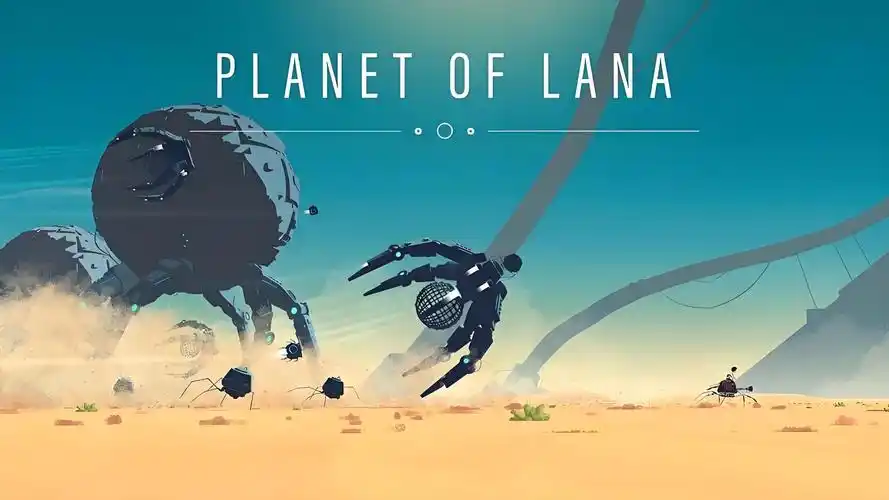
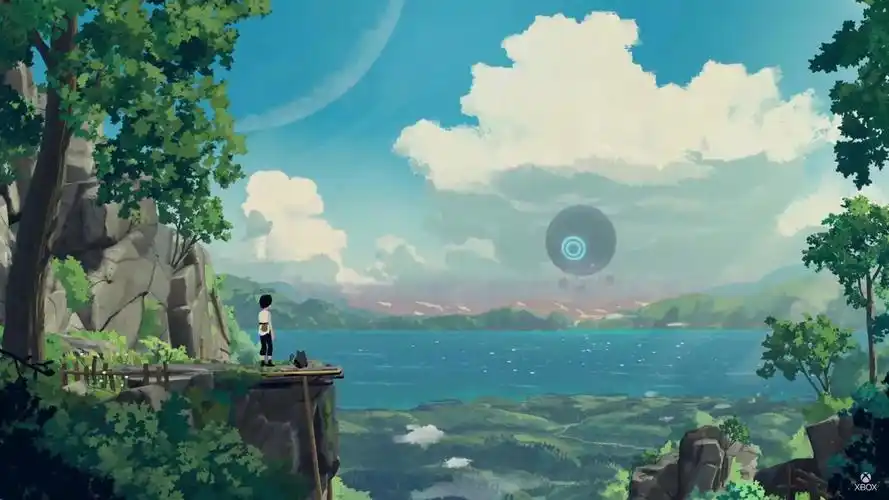
Developed by Wishfully Studios and released in 2023, Planet of Lana is a side-scrolling puzzle-adventure set on a world that resembles Earth but is not quite Earth — a planet of golden grasslands, turquoise oceans, and ancient stone ruins that has been invaded by hostile machines. You play as Lana, a young girl who is separated from her older sister during the initial attack. In the chaos, she rescues a small, cat-like creature named Mui, and the two of them embark on a journey across the planet to find Lana’s sister and uncover the mystery of the invading machines. The game is wordless, relying entirely on visual storytelling, environmental cues, and the evolving bond between Lana and Mui to convey its narrative.
The Companion System and Cooperative Puzzle Logic
The defining mechanic of Planet of Lana is the partnership between Lana and Mui. Lana can run, jump, climb, and interact with switches and levers. Mui can perform a complementary set of actions: she can jump to higher platforms, squeeze through narrow gaps, attract the attention of certain creatures, and, crucially, manipulate the behavior of the planet’s native fauna.
The puzzle logic of the game is built around dividing tasks between the two characters. A typical puzzle scenario might involve Lana standing on a pressure plate to hold open a door while Mui runs through to the other side and cuts a rope that releases a bridge for Lana to cross. Another might require Mui to attract a hostile creature’s attention so that Lana can sneak past. The game introduces each new Mui ability in a safe environment before requiring you to use it under pressure, ensuring that you never face a challenge without having been taught the tools needed to solve it.
Mui’s commands are simple and context-sensitive. You can direct Mui to move to a specific location, stay in place, or interact with an object. The game never requires complex multi-step commands; every puzzle can be solved with straightforward instructions. The challenge is not in the execution but in the observation — recognizing what Mui can interact with and what each interaction will accomplish.
The creatures that populate the planet are not enemies in the traditional sense. They are animals, driven by instinct, and Mui can influence their behavior. A burrowing creature that tunnels through the ground can be directed to create passages. A large, lumbering herbivore can be startled into charging through obstacles. An aerial creature can be coaxed into carrying Mui across gaps. These interactions are the heart of the game’s puzzle design, and learning to read the behavior of each creature type is essential to progression.
Chapter Walkthrough and Key Puzzle Solutions
Chapter 1: The Invasion introduces Lana’s basic movement and the bond with Mui. The machines attack Lana’s village, and she is forced to flee. The puzzles here are simple — climb ledges, crawl under debris, avoid the machines’ searchlights. The chapter ends with Lana and Mui escaping into the wilderness.
Chapter 2: The Cliffs introduces vertical traversal and Mui’s ability to cut ropes. The central puzzle involves a collapsed bridge that must be rebuilt by finding and cutting the ropes that hold its segments in place. Mui must climb to locations that Lana cannot reach and chew through the ropes, while Lana positions herself to receive the falling bridge pieces.
Chapter 3: The Swamp introduces the first creature that Mui can control — a large, worm-like animal that tunnels through the soft ground. Directing the worm to create tunnels allows Lana and Mui to bypass collapsed passages and reach new areas. The swamp also features the game’s first stealth sections, where Lana and Mui must avoid the machines’ patrols by hiding in tall grass and under water.
Chapter 4: The Desert is the game’s largest and most open chapter. The central mechanic here is a creature that can be startled into charging, breaking through walls and other obstacles. The desert also introduces environmental hazards — sandstorms that reduce visibility and heat that drains Lana’s stamina. Mui’s ability to attract creatures becomes essential here, as you will need to lure the charging creature to specific locations to break through barriers.
Chapter 5: The Mountains introduces the aerial creature that can carry Mui across gaps. The puzzles in this chapter are vertical — you must use Mui to reach high platforms and then find ways to bring Lana up after her. The chapter ends with a harrowing sequence in which Lana and Mui must navigate a crumbling mountainside while pursued by machines.
Chapter 6: The Machine City is the game’s final chapter and its most visually spectacular. The puzzles here involve disabling the machines’ infrastructure — shutting down generators, rerouting power, and ultimately confronting the source of the invasion. The final sequence requires Lana and Mui to work in perfect synchronization, and it culminates in a choice that will determine the fate of both characters.
Hidden Shrines and Collectible Locations
Scattered throughout the game are hidden shrines — ancient stone structures that predate the human settlement of the planet. Each shrine is a small puzzle in itself, requiring Lana and Mui to activate a series of glyphs in the correct order. The shrines are not marked on any map, and finding them requires careful exploration.
There are ten shrines in total. Collecting all of them unlocks a hidden chamber in the final chapter, which contains a mural depicting the history of the planet — the arrival of the machines, the fall of an ancient civilization, and the origin of the bond between humans and creatures like Mui. This mural provides the only explicit narrative context for the game’s events, and collecting all the shrines is essential for a full understanding of the story.
Key shrine locations include a hidden cave behind a waterfall in Chapter 2, a submerged chamber accessible only by redirecting a stream in Chapter 3, and a shrine perched atop a crumbling column in Chapter 4 that requires precise platforming to reach.
Ending Interpretation
The ending of Planet of Lana is ambiguous in the best possible way. Lana finds her sister, but the reunion is not the end of the journey. The machines are not defeated; they are understood. The game’s final moments suggest that the invasion was not an act of conquest but of desperation — that the machines were fleeing something, and that their arrival on this planet was as involuntary as Lana’s flight from her village.
Mui’s role in the ending is central. The bond between Lana and Mui, built over the course of the entire game, becomes the means by which communication between the humans and the machines becomes possible. The game’s final image is not one of victory or defeat, but of connection — two species, one organic and one mechanical, finding a way to coexist.
The narrative of Planet of Lana is, at its core, a story about empathy. Every puzzle in the game requires Lana and Mui to work together, and every step of their journey is made possible by their willingness to trust each other. The game’s ending extends that logic to a planetary scale. The solution to the conflict is not violence or escape, but understanding. The machines are not monsters. They are refugees. And Mui, a small creature from a quiet world, is the bridge between them and the people who call that world home.